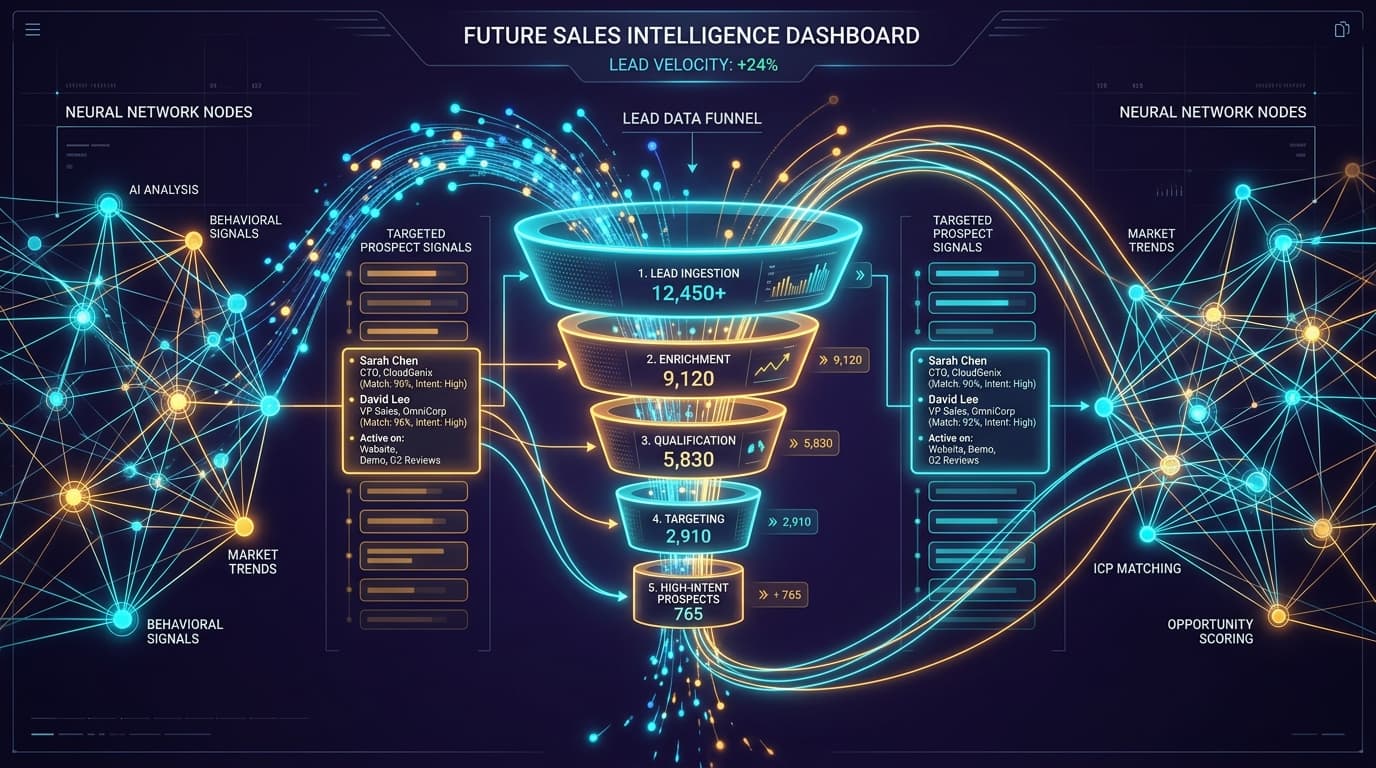
Quick answer: AI Lead Generation Systems: B2B Automation Guide (2026) explains how to combine data, model-driven personalization, multi-channel outreach and strict delivery controls to generate qualified B2B opportunities at scale. This guide is for marketing leaders, revenue ops, and technical product owners evaluating or building production-ready AI lead generation systems with human oversight.
Author: Wizora Studio — Updated: 2026. Sources and companion guides are linked at the end.
Summary and key takeaways
- AI lead generation systems pair verified intent and contact data with models that generate contextual, trigger-based messaging — not generic mass mail.
- Success depends more on architecture, data intent quality and deliverability controls than on any single model or tool.
- Production-ready systems follow a stage-based prospecting architecture, include human-in-the-loop checks, and enforce deliverability, compliance and observability from day one.
- Before automating outreach, validate ICP, data sources, enrichment rules and handoff logic to avoid creating an expensive spam engine.
How AI lead generation systems work: architecture & workflow
At a high level, an AI lead generation system ingests signals, enriches and scores prospects, composes contextual outreach, executes multi-channel sequences, classifies replies, syncs to CRM and routes qualified prospects to sales. The core architectural layers are:
- Data layer: Verified contact and account records from third-party providers plus first-party telemetry (web, events).
- Enrichment and intent layer: News, hiring signals, technographic and behavioral indicators used to calculate fit and intent scores.
- Model & personalization layer: Prompted or fine-tuned models that create contextual openers and message variations tied to identified triggers.
- Execution & delivery layer: Sequencing engine that orchestrates email, LinkedIn and other channels while managing sending domains and reputation.
- Observability & compliance layer: Logging, reply classification, audit trails, and rules for opt-outs, GDPR/CASL handling and retention.
- Human handoff: Briefing packets and CRM workflows that put prospect context in front of sales reps at the right time.
Practical example: The 9-stage B2B prospecting architecture
- ICP Definition: Map firmographic, technographic and behavioral filters into a canonical schema so downstream scoring and routing are consistent.
- Data Sourcing: Pull verified contacts from sources like Apollo, ZoomInfo or Cognism and tag provenance for traceability.
- Enrichment Waterfall: Run news, hiring and stack signals through an enrichment pipeline (e.g., news APIs, GitHub, job boards) and attach the results to account records.
- Intent Lead Scoring: Combine fit score and recent buying signals into a composite ranking used to prioritize outreach cadence and channel mix.
- Contextual Personalization: Use models to generate message openers that reference fresh triggers (e.g., recent funding or a public hiring) rather than static merge tags.
- Multi-Channel Outreach Execution: Orchestrate email, LinkedIn and sequences with fallbacks and suppression rules to prevent over-contacting the same account.
- Reply Classification: Automate triage of replies (positive interest, nurture, opt-out, status updates, out-of-office) and apply escalation rules for human review.
- CRM Sync: Log full activity and enrichment snapshots to HubSpot or Salesforce with provenance fields and timestamps for auditability.
- Human Sales Handoff: Deliver a concise briefing to reps including intent reasons, recent triggers and suggested next steps to increase conversion efficiency.
Implementation & integration: APIs, deployment and human-in-the-loop
Key implementation considerations:
- API-first integrations: Use robust connectors for data providers, email providers and CRM systems so enrichment, sending and logging are reliable and traceable. See our integrations work at AI integrations.
- Modular deployment: Separate enrichment, model inference and delivery into microservices or serverless functions to control costs and scale components independently.
- Human-in-the-loop (HITL): Gate high-impact messages (e.g., enterprise-targeted sequences) to a review queue where a human can approve or edit generated content before send.
- Audit trails and explainability: Persist the prompt, model responses, enrichment snapshot and decision rationale for every outreach item to support debugging and compliance.
- CRM automation: Keep CRM sync logic idempotent and small — use proven patterns from CRM automation to avoid duplicate records or race conditions.
Best practices: deliverability, compliance and security
Deliverability and legal compliance are core differentiators. Non-negotiables include:
- Authentication: Properly configured SPF, DKIM and DMARC for sending domains and subdomains.
- Domain separation & warm-up: Use isolated sending domains or subdomains, progressive warm-up and throttled cadence to protect brand reputation.
- Data governance: Track consent provenance, lawful bases for processing and retention policies consistent with GDPR, CAN-SPAM and CASL.
- Unsubscribe & suppression handling: Centralize suppression lists and honor opt-outs across channels in real time.
- Security controls: Encrypt data at rest and in transit, limit PII exposure in prompts and logs, and rotate keys per standard practices.
- Deliverability monitoring: Monitor bounces, spam complaints and inbox placement; tie anomalies to recent changes in cadence, copy or lists.
For a focused checklist, see our deliverability and compliance companion guide at Deliverability & Compliance Non-Negotiables.
Costs, timeline and production deployment considerations
Cost and time-to-production depend on scope and the following drivers:
- Data licensing model and volume (third-party provider fees).
- Complexity of enrichment waterfall and custom intent signals.
- Degree of HITL required and workflow complexity for sales handoff.
- Regulatory requirements that affect storage, consent and retention.
- Operational readiness: domain reputation, deliverability tooling and monitoring.
Plan projects in phases: discovery (ICP and data), prototype (small pilot with strong observability), iterate (optimize scoring and templates) and scale (broader rollout with domain and team readiness). If you want help scoping an implementation, our AI lead generation automation service can provide an audit and implementation plan.
Limitations, risks and monitoring
- Data quality risk: Low-quality or stale data leads to poor deliverability and wasted sends — always measure source accuracy and decay rates.
- Model hallucination and bias: Generated text can include incorrect assertions; use HITL or verification steps for any factual claims used in outreach.
- Deliverability drift: Sudden increases in volume or template changes can trigger spam filters; instrument staging tests and inbox placement checks.
- Regulatory risk: Cross-border rules for consent and personal data require careful legal review and documentation.
- Operational complexity: Multi-source integrations and real-time enrichment introduce more failure modes; invest in retries, idempotency and fallback logic.
Monitoring signals to track: bounce rate, spam complaints, reply classification accuracy, lead-to-opportunity conversion, model suggestion approval rates and data source health metrics.
Production checklist for readiness
- Defined ICP and documented enrichment rules.
- Proven data sources with provenance tags and decay strategy.
- Authenticated sending domains with warm-up plan and suppression list handling.
- HITL approval workflows for sensitive segments and templates.
- CRM sync with idempotent logging and clear sales handoff signals.
- Observability: audit trails for prompts, model outputs and decisions.
- Compliance documentation for data processing, opt-outs and retention.
- Run a controlled pilot and measure deliverability and conversion before scaling.
When to hire: services, consulting and implementation partners
Consider bringing in external support if you need any of the following:
- Architect-level design for multi-source enrichment and intent scoring.
- Implementation of secure, audited model inference layers and prompt management.
- Deliverability and domain reputation remediation.
- Full-stack integration with CRM and sequencing engines.
Wizora provides consulting, implementation and automation services — start from a focused audit or pilot. Explore our services at AI automation and the specialized lead generation automation page. For examples of deployments, see our portfolio at Work or request a free audit via Contact.
Related guides and next steps
- The 9-Stage B2B Prospecting Architecture — detailed walk-through and templates.
- Deliverability & Compliance Non-Negotiables — operational controls and checks.
- AI automation workflows for real estate agencies — industry-specific example.
- Replacing Zapier with n8n — infrastructure decisions for automation scale.
Evidence qualifier: this guide describes architecture and best practices based on common production patterns; outcomes depend on data quality, governance and operational rigor rather than any single vendor or model.
Ready to assess your readiness or scope a pilot? Request a free audit through Contact or learn how we implement these systems via our lead generation automation service.